Playing the library card
1969 (seven years old): My library card was my best friend. The two-room Glenorchy library was my best friend’s best friend. Most kids were limited to two books at a time. I was allowed six, and I made a serious attempt to read every book I took home. And I made a serious attempt to take home every book in the library. I remember reading about the impending ice age, and Tom Swift’s tri-phibian atomicar. I planned for the coming techno-utopia. Chocolate would be delivered to my house via pneumatic tubes.
My brother gave me The Guinness Book of Records for Christmas. I learnt most of it off-by-heart. Robert Wadlow, Lucia Zarate.
1972 (ten years old): I had refined my interests to science and science fiction. The blazer of my school uniform was never without a paperback in each pocket. My holy grail: the elusive Report on Planet Three and other Speculations, by Arthur C. Clarke (it remained elusive until one minute ago, when I bought a digital copy from Apple Books for $7.99).
1975 (thirteen years old): Still into science fiction but my major literary pursuit was classic literature. I decided that Crime and Punishment was the greatest of all books (and I haven’t changed my mind), but having recently ‘converted’ to atheism, I was quite taken with Pervoyedov, one of the dead in Dostoyevsky’s short story ‘Bobok’. Pervoyedov didn’t mind being dead, which gave me some comfort in the face of the possibility that ‘life’ persisted beyond the grave.
Along with atheism came the realisation that one man’s fantasy utopia (I was also starting to understand that it’s usually men who try to take control) can induce a whole world of pain.
My student life had always been made comfortable by a proclivity for scholastics, and books had usually kept me years ahead of the school syllabus. That was weaponised when the anti-academic Catholic school that I attended, faced with my upstart learning, made me skip a grade (eight), forcing me ever further from the academic slalom tracks.
My sister gave me Donald H. Menzel’s Astronomy. It enabled an obsession that has only slightly waned in the intervening years.
My mother gave me Isaac Asimov’s Nine Tomorrows. My first reading caused confusion. I expected a novel, I got short stories. But ‘The Last Question’, an existential excursion into our value as a species, became a favourite, and so it has remained. It has been joined by Robert Heinlein’s ‘The Unpleasant Profession of Jonathan Hoag’, Clarke’s ‘The Nine Billion Names of God’ and ‘The Star’, Ambrose Bierce’s ‘Incident at Owl Creek Bridge’, Fritz Leiber’s ‘A Pail of Air’, and Jack London’s ‘To Build a Fire’. Append to this elemental list the aforementioned ‘Bobok’, by Fyodor Mikhailovich Dostoyevsky.
All that I know of myself is compounded in those stories.
1978 (sixteen years old): I had escaped the Catholic mediocrity for Elizabeth College, and the most satisfying component of that excursion to reality was engaging with kids that were as certain as I was that the most exuberant sense we possessed was the sense of wonder. Some people I met then are still my friends. Others only stopped being my friends when they stopped being beings.
Mathematics, already fetishised in my analytical mind, became a wellspring of joy when I encountered Mathematics and the Imagination in the school library. Maths was no longer something to be learnt. It became a mechanism to massage reality until it yielded poetry.
A year later, my wonderment vastened when Douglas Hofstadter’s Godël, Escher, Bach exploded my serenity.
1981 (no longer a kid): My mates had inveigled me into casino gambling (the casino in Hobart is across the road from the university). It became clear that their systems were sound but they moved into the arena of profound when I discovered John Ferguson’s Professional Blackjack and Peter Griffin’s Theory of Blackjack, ironically in the little shop at the casino. Some years later I met Peter Griffin, whom I thought a complete tool. My respect for his analytical technique maintains. Books are more important than authors.
But it was in 1981, however, that I encountered the book-that-really-matters-to-me, at the State Library of Tasmania. Without Richard Epstein’s Theory of Gambling and Statistical Logic, I doubt I would ever have understood how to think about risk—the universe’s will is expressed in statistical mechanics.
The path from then to now is a bramble, and I think it’s only through good fortune that I picked the fruit without being punctured by the thorns. Nevertheless, Epstein was my scythe through that thicket. It’s difficult to appraise, but without Theory of Gambling and Statistical Logic there’s a good chance that there’d be no Mona, and no library.
Yes, that’s what this is all about. Over the years I’ve collected books and documents and maps and all things literary and learned. I’m a hoarder (I still have my sister-gifted copy of Menzel’s Astronomy) so I’ve got an enormous amount of material, but I’ve never shown it. Why is Mona an art museum and not a library? That might be because I was thinking about the nature of creativity, and why it is that we care about beauty, and that was more easily pursued within the aesthetic than the philosophical. Or it might be because I had no original ideas to animate a library.
I’ve sure got one now.
Library cataloguing systems like Dewey and the Library of Congress were introduced in the nineteenth century. They order knowledge and they order books on shelves. That helps: we can browse in (somewhat) related sections, and find stuff that is (somewhat) related to our interests. It helps if books are about one thing. A book about Mars should be near a book about Mercury if we are talking planets. But if the book is also about Roman mythology, we’d be browsing mythology, and we’d not find what we were looking for.
Unless our cataloguing system allows us to organise books however we want. At Mona, we are making librarians into curators. I could tell you more, but that would spoil the surprise. I think what we are doing is very surprising indeed. And worthwhile. And wonderful.
1984: What about 1984? It’s here for symmetry, and it articulates one of the most ubiquitous of all warnings about the quest for utopias. I didn’t like the book much, and the year wasn’t great either. The gambling wasn’t paying off—my maverick tendencies weren’t paying off, and I wondered if I should return to the academic fold. But I didn’t. I stayed off-piste.
And I got lucky.
1985: The turning point. Playing blackjack in Vegas, and losing. But spending all of my spare time in the University of Nevada, Las Vegas (UNLV) library. UNLV had relentlessly documented the world’s gambling research: published and conference papers; theses; even recordings of lectures. I learnt a whole lot, and the under-utilised librarians made copies of everything I wanted to take with me.
1988: By then we were ahead of the game. By 1991 I was, by most measures, rich. And in 1995 (sorry about the broken symmetry), I bought the site that houses Mona, which is now joined by Phrontisterion. And thus became poor, again.
I was always all-in on books and libraries. My first library card was the great leveller, the thing that gave impoverished child-me a chance to seek. I wasn’t so impoverished at all, because I lived in a society that, despite its many failures, put libraries in suburbs, books in hands, and opportunity within reach.
Mona is in Glenorchy, an eddy swirling around a backwater. It’s the vortex I was caught in, escaped from, returned to, and am in thrall of. And now, Glenorchy is the home of Phrontisterion.
2026: From libraries I came, and to libraries I return.
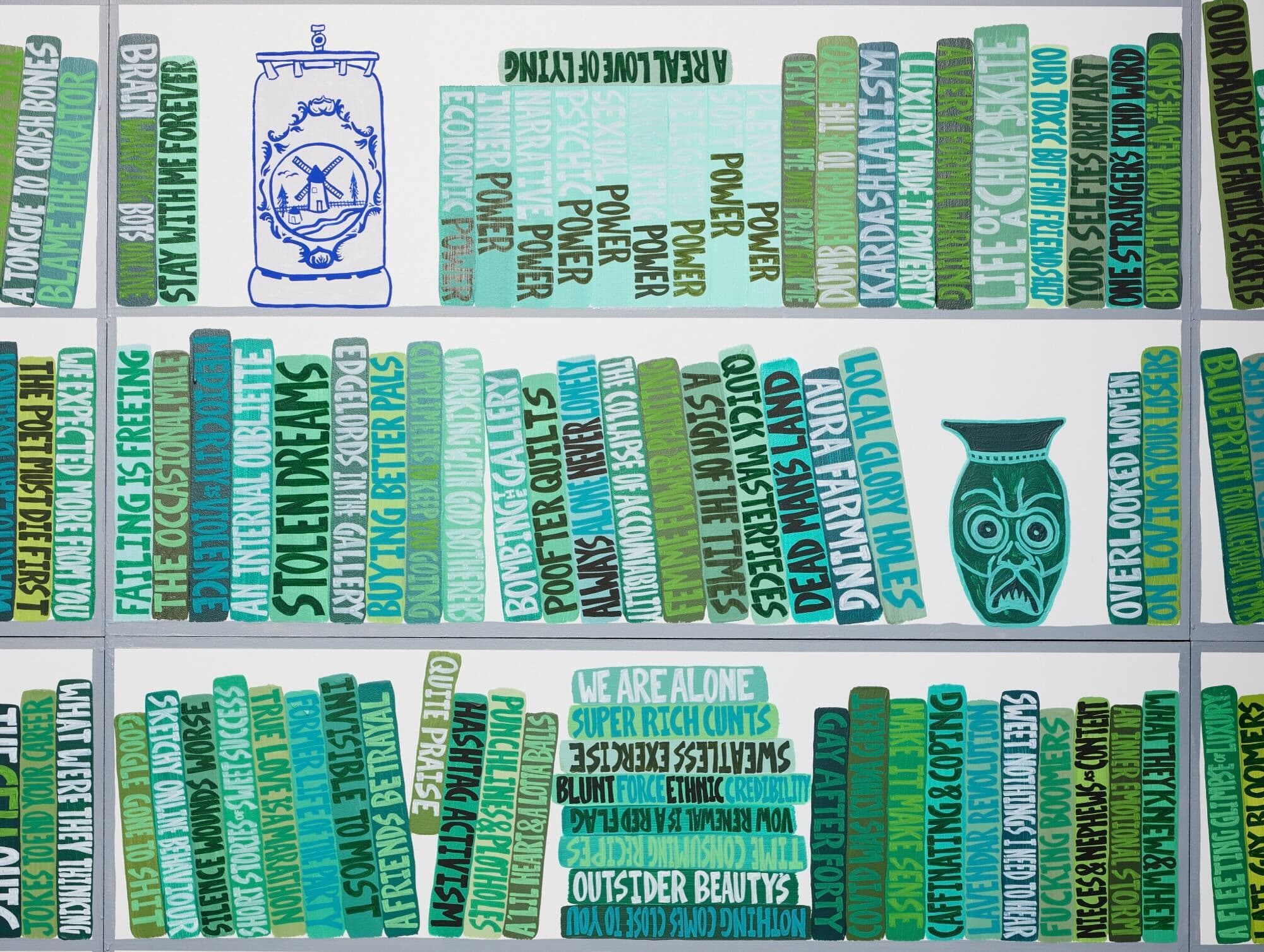
Image: A Library (Imagine Sisyphus Happy) (detail), 2026, Lucas Grogan
Acrylic paint on hoop pine ply