Surrender Room
Indigo is the daughter of Joshua and Jo Yeldham, and along with Indigo’s brother Jude, they are the subject of a monumental artwork that will open tomorrow, with Mona’s new library, Phrontisterion. Indigo ponders her dad’s motives in this essay.
I am standing next to a portrait of myself at the far right end of my father’s newest work. The ten-metre panoramic installation is built into a charred timber undercroft below layers of sandstone under the new library at the Museum of Old and New Art in Hobart. On the opposite end is his self-portrait.
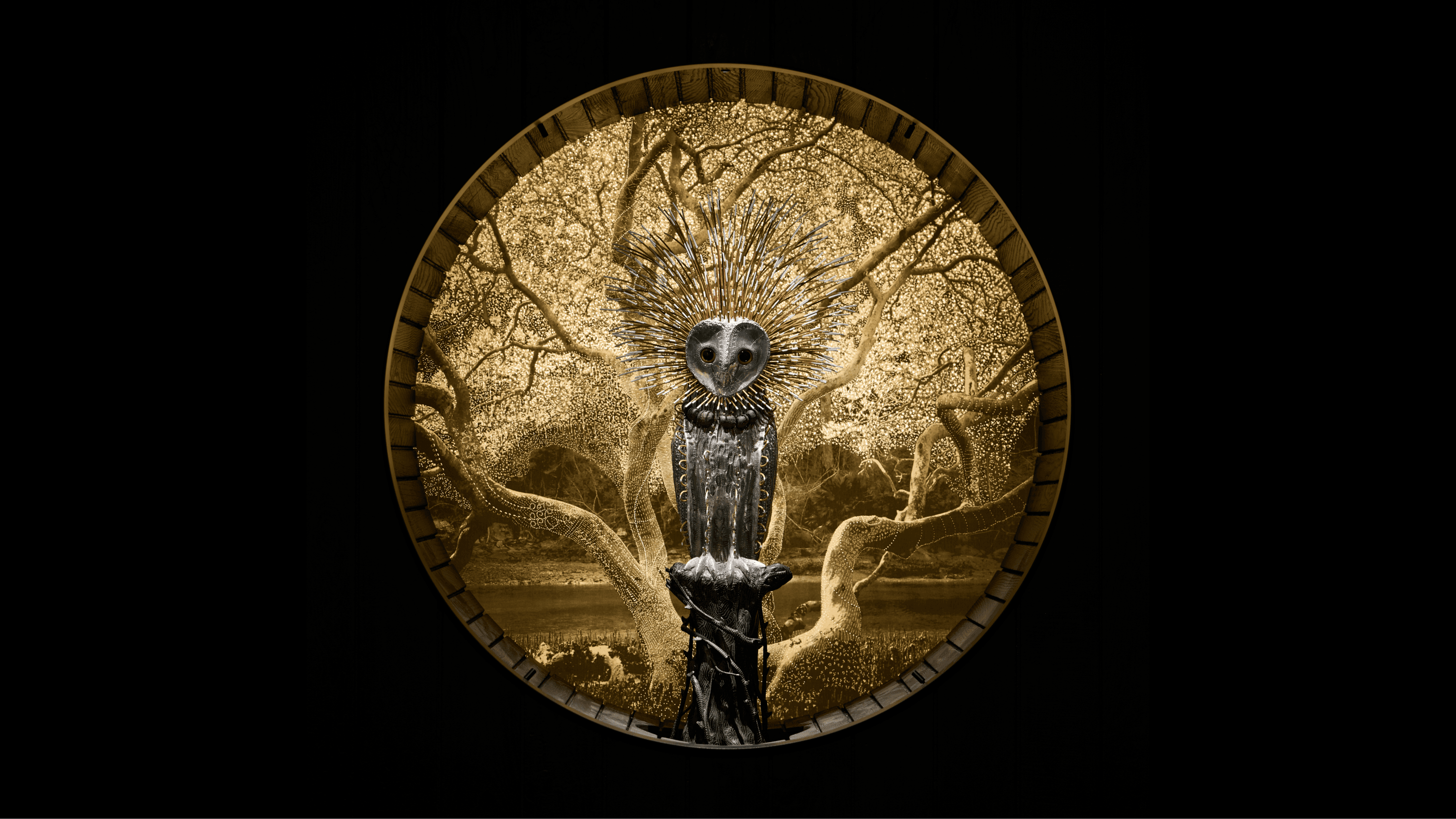
Between us stretches more than two decades of a mythology he has created compressed into paint, mechanics and sound. At the centre, an owl holds an embryo in its talons. To one side, my mother sits astride a double-headed horse with an Edwardian clock embedded in her womb. A snake coils nearby. My younger brother stands by a tree stump with an owlet on his arm and singing bowls at his feet. And here, at the far edge, I hold a ladder that reaches upwards towards a kangaroo skin drum that beats overhead. The installation plays itself. Guitars strum in the belly of its figures. A spinning wheel with brass bells adorns the horse’s bridle. Each sound finds its place within the melody of the clock inside my mother’s womb.
This work tells my father’s story of how my brother and I came to exist. It maps what happened to him when his biology denied his and my mother’s desires, and the structures he had to build to survive his grief upon discovering that he was infertile.
In 2002, my parents began IVF. They learnt the language of clinics: follicle counts, embryo quality and implantation success rates. They learnt to measure hope in cycles and that longing is not leverage. My father, despite his infertility, was on the periphery of the process. The medical burden landed on her body. The injections marked my mother’s skin. The hormones, the appointments, the procedures, the waiting rooms, the bruises. Her cycles became the site of a negotiation. He could not bear this burden and carry it for her. He stood somewhere adjacent to all of it; a former filmmaker with nothing to film, a maker with nothing to make, his hands opening and closing on air. So he built something.
He decided that the owls circling the bushland around our home were stealing their embryos, and if these creatures of prey were the custodians of fertility, perhaps they could be reasoned with. Science was just one system, but there had to be others. So he painted them. Owls perched like sentinels, suspended in the act of taking or maternal with babies of their own, clutching their infant cargo. He built them landscapes, gave them instruments, furnished their dominion with sound and rhythm. Because if they were going to conduct their midnight thievery and take what was his, he would at least make them answerable to something. He carved wood until it yielded a matrix of line work resembling their habitat. He layered acrylic around their eyes until it thickened into belief. He built a universe in which his longing had shape and his studio became a parallel clinic. When a future we had already furnished evades us, we enlarge language until it can house our grief. These lexicons are the most compelling, singular things we create as humans. They don’t need to make sense to anyone else.
At the centre of the work, following on from my father’s self-portrait, an enormous owl appears mid-flight. In its talons, an embryo hangs suspended, spinning hypnotically. To the right of the owl is my mother’s clock. Women live inside clocks long before we understand them. We are taught early that time is housed in our bodies. That there is a ‘window’, that fertility declines, that there is a right age to find love, be married, have children, indulge in a career—all before the sand runs out. Years of pattern-making, deadlines, timelines and inherited ideas of right and wrong have already converged to set its course.
Men have timelines too, but they do not feel them in their flesh. Their lives are not framed by cycles. Still, we all encounter obstacles that demand negotiation. Instead of meeting his grief in private, my father met his with excess and he testified to it. He turned it into ceremony. He made it strange. He made it public. And then when we were born, he raised us inside the landscape that had held him while he waited. The bushland, the river, the owls that circled at night. He did not hide his inner world from us. He involved us in it. We grew up knowing that we were wanted, intensely, unapologetically. Sometimes in ways that felt Odyssean, sometimes in ways that felt real and heavy.
Beside a snake sitting alert on a tree stump, my younger brother holds an owlet. The bird that once represented loss now rests in his hand. The motif has softened and the captor has become a companion. I stand next to my brother at the edge of the work with a ladder that extends up towards a drum that beats overhead, its rhythm a constant in the composition. For me, the ladder’s presence does not represent a guaranteed arrival at a destination or the conclusion of the work and its narrative. It suggests a continuous ascent. It suggests labour.
I am twenty-two now. Old enough to recognise the quiet culpability my father must have felt when he learnt he could not conceive without assistance. Old enough to recognise the disproportionate weight my mother carried while he continued to construct a fable. Old enough to feel time tightening around my own decisions. My own internal clock may not yet be governed by the same urgency, the same desire as my mother’s was. But I do know that time doesn’t feel neutral, it is asking something of me. I just don’t know how much the ticking sound of the clock is inside my body and how much is inside my culture.
What interests me now is not whether the owls were real or the paintings constituted, in any measurable form, a negotiation with fate. What interests me is that he had to make something. The owl was never about birds. It was about building a nest for fear.
We do not think our way out of sorrow, we build our way through it by giving it feathers, making it strange, peculiar and ours, and then in the naming and the making, something is altered. The facts don’t change, but the weight of them does. Some build elaborate mythologies. Some build narratives. Some build silence. Some build resentment that hardens over years into something that no longer resembles what it came from. Some build faith. Some refuse ceremony altogether. There is, in everyone, an attempt at reconciling the life we expected with the one that arrived. The owls were my father’s way.
Across the ten metres of the Surrender Room, my father’s painted gaze meets mine, the painted me and the real me. He gave me a ladder to hold. It does not promise certainty, it suggests movement. I am written into this work, and now I am writing back to it. What I choose to build on the rungs above is mine. What my father built out of his experience is his. And now, having walked the length of this wall and heard the beat of this story, it is also, however you may have witnessed it, yours.
Images:
Surrender Room (detail), 2025–26, Joshua Yeldham
Site-specific installation, mixed media
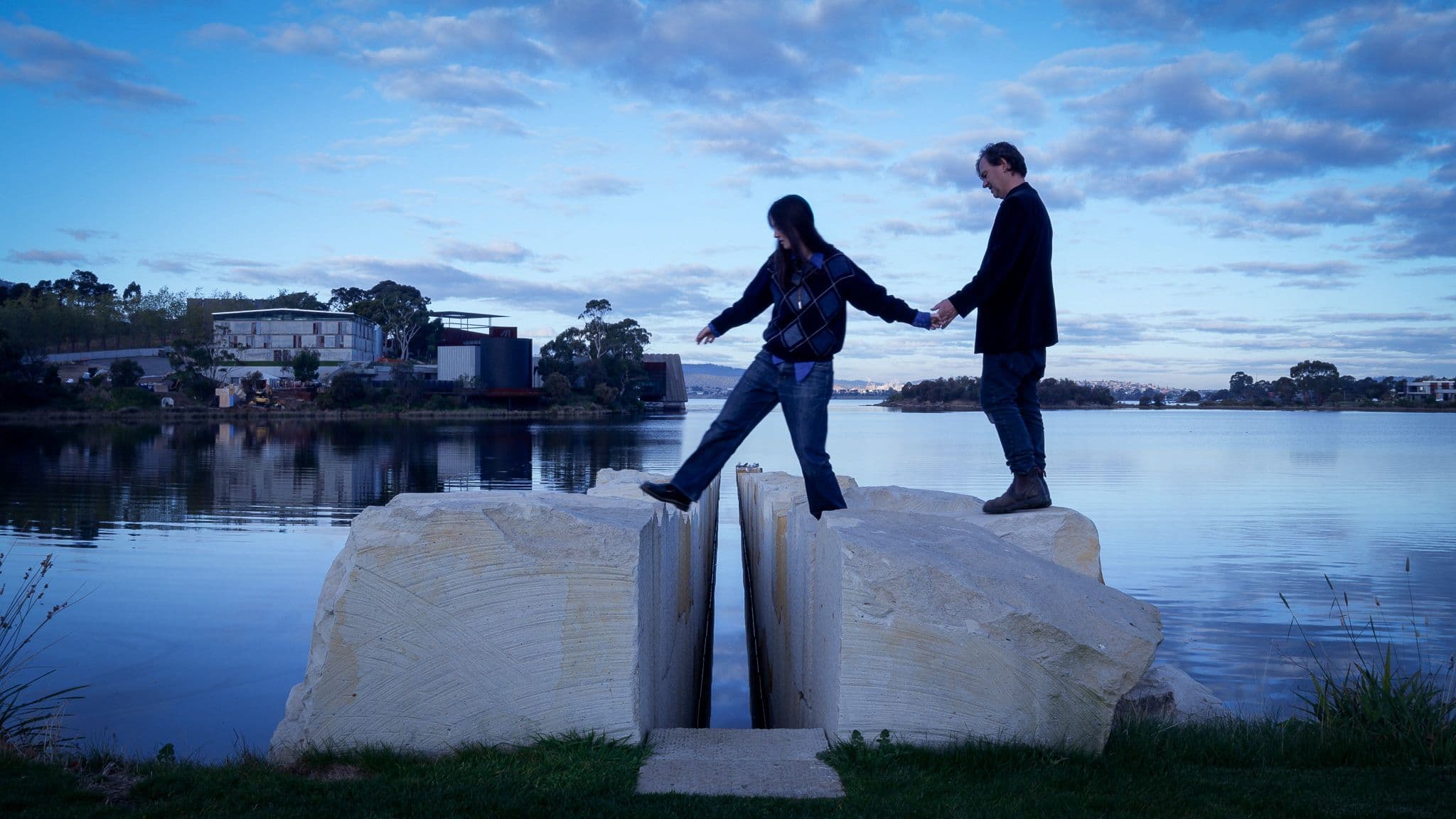
Indigo and Joshua Yeldham with Stone Sea Passage, 2024, Andy Goldsworthy
Sandstone
With Mona in the background